
Thy Greatest Ally Part One - The Creation of Modern Israel

In my last article, we explored post-WWI Germany; about how, from the Weimar Republic's catastophic governance to the debauchery and depravity of 1930's Berlin, Germany was left facing a choice between the competing extremes of communism and fascism and chose the latter in an attempt to save their nation and culture.
That of course set the stage for the greatest war humanity has ever seen and a dramatic shift away from any nationalist ideas in the west ever since, something that is now coming home to roost with the "globalist" ideological takeover of recent decades and the mass immigration which has followed.
If you haven't read that piece, I'd highly recommend at least reading this section prior to today's article, as it goes over some of the basic definitions involving the Jewish identity - Judaism, secular vs. Orthodox Jews, what the Torah and Talmud are, etc.
Once you're up to speed, we can move on to today's focus - the birth of modern Israel.
Due to its complexity and depth, my long-anticipated article on Israel required splitting in order to make it more digestible - now a series, these articles will cover not only Israel's inception (which is the focus of this feature), but also Israel's parasitic relationship with the United States, the nation's history of "false flag" attacks, the Talmud and Jewish supremacy, Jeffrey Epstein and Israel's history of harbouring pedophiles and rapists, and America's current war with Iran.
Since many today automatically accuse anyone who criticizes Israel as a "Palestine supporter" or "terrorist sympathizer", I'd like to make one thing clear - I have long been against Islam and have even written about how it is diametrically opposed to the western way of life, a belief I still firmly stand behind.
Just because someone does not support Israel, it does not mean they have to support Islam nor does it mean they are "antisemitic" - as will be established in this piece, there are many valid reasons to not support the state of Israel and to be opposed to not only the state's actions over the past decades, but its formation as a country in the first place.
As I will explore in this article and in the series' future posts, anyone who claims to be against terrorism, should also stand vehemently against the state of Israel.
If this triggers you or has you wanting to scream "antisemitism!", I'd implore you to read on and give yourself some time to re-evaluate your stance after digesting the historical facts that follow.

Zionism and the Birth of Modern Israel
You may have heard the words "Zionism" or "Zionist" thrown around recently, but you may not know its actual definition - Zionism is a political movement for Jewish nationalism that focuses on the establishment and expansion of an official Jewish homeland.
Emerging in the late 19th century amid growing European anti-Jewish sentiment (through no fault of their own of course), Zionism was formalized by Theodor Herzl and quickly gained support amongst Jewish people around the world, with the promise of their own state which would act as a safe haven for all Jews going forward.
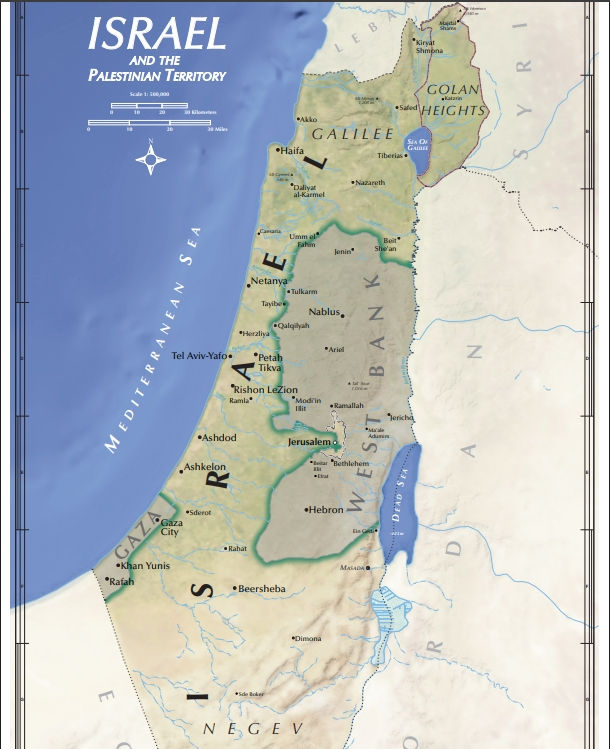
This homeland couldn't just be any patch of land however - it had to be the ancestral territory of Israel (see the map above), which Jewish people had once ruled over but had since largely dispersed from nearly two thousand years ago after losing multiple wars to the Romans.
According to the Jewish faith, this ancient land known as Israel was "promised" to the Jewish people some three thousand years ago by Yahweh (God), which is recorded in the Torah, thus even though there hasn't been a Jewish state or even simply a majority-Jewish country in the area for nearly two millenia, Zionists believe they still have a more righteous claim to ownership of that land over people who have been living on that land for centuries.
Prior to World War I, a portion of that land (including the holy city of Jerusalem, which served as the capital of ancient Israel) fell under what was known then as Palestine, a region of the Ottoman Empire that unlike most areas around the world, was not officially a state or country and didn't have its own official government.
Instead, the region of Palestine was shared by various faiths for hundreds of years (by the early 1900's, it was roughly 85% Muslim, 10-11% Christian, and 4-5% Jewish) with its population mostly living in small farming villages and historically significant cities like Jerusalem, Jaffa, and Acre.
The Palestinian community largely lived in peace, sharing historic sites and going about their individual business without much issue, but without its own statehood or even a proper government to adequately protect it, the land of Palestine made the perfect target to begin establishing a new Jewish stronghold.
Zionism quickly made progress courtesy of the British Empire and the British desire to gain Jewish support during World War I.
As Britain steadily overwhelmed the Ottoman Empire during the Great War, which at the time had the area of Palestine under its authority, Britain gained control of of Palestine as a result.
In 1917, the Balfour Declaration was issued by the British government, an open letter from Arthur Balfour (British foreign secretary) to Lord Rothschild, a "leader" in the British Jewish community, which announced the British government's support for creating a "national home for the Jewish people" in what was then known as Palestine.
This declaration posed a major problem however - the British had already promised that land to other Arab leaders, promising it could become an independent Arab state.
Following World War I and the Ottoman Empire's collapse, the League of Nations granted Britain formal control over the Palestinian region.
Under British rule, Jewish immigration surged as Jews fled persecution in Europe, leading to growing nationalist sentiment from both the majority Arab population and the rapidly growing Jewish community.
Land disputes became common, as during the Ottoman's control of the region, the Ottoman Empire's land registration system sported vague boundaries and large tracts of land were claimed by wealthy elites and urban families who had no actual ties to the land.
In many cases, these "absentee" landlords had never even stepped foot near the land in question nor paid anyone for its "ownership", yet the Ottomans acknowledged them as the owners of the land over the local farmers who had worked and effectively owned that land for generations.
The British relied on those Ottoman registries, with Zionist groups (namely the Jewish National Fund) and private Jewish buyers purchasing land from those absentee landlords, displacing the peasant farmers who had built their homes and worked the soil on that land without any compensation.
Unsurprisingly, this led to increasing conflicts, with small skirmishes breaking out between Arab and Jewish civilian groups. These groups formed local militias and small-scale terrorist bombings and attacks on each other as well as civilians began coming from both sides, with Britain stepping in to maintain order only when absolutely necessary.
The Palestinians repeatedly petitioned the British, starting in 1918, to create a democratic state where elections would be held and the will of the population would be respected.
Considering the west's history and their very public claims of supporting democracy above all else to this day, it was telling that Britain completely dismissed such calls for establishing a democratic state as soon as it went against Jewish interests.
With Palestinian Arabs taking up the majority of the population of Palestine (even after WWII, following decades of mass Jewish immigration), a democratic state wouldn't have given Zionists the ethnostate that they desired nor the unchallenged rule over the "holy lands" that they demanded.
Harry S. Truman, who served as US President from 1945 to 1953, explains in this archival footage that the Jewish side, particularly the Zionists, were against any solution that didn't give them all of Palestine, and he even states that many Jews wanted to "drive all the Arabs into the Tigris and Euphrates rivers".
As unrest mounted amongst the Arabs and the increasing Jewish population, in 1937, the British proposed splitting the land into a small Jewish state, an Arab state, and an international British corridor, but this was roundly rejected by Arab leaders and failed to gain traction amongst Zionists either, leading to this idea ultimately being abandoned by Britain.
Unable to satisfy either side, British forces and government workers soon found themselves targets in the conflict - between 1936 and 1939, the Arab Revolt saw guerilla tactics used by Palestinian Arabs against British rule and mass Jewish immigration, with oil pipelines and railways being targeted alongside British patrols.
As a result, Britain militarized the area to quash the resistance; later, Jewish militia groups like the Irgun and Lehi would turn their sights on the Brits as well starting in 1944, with attacks on British infrastructure becoming a regular occurrence.
Most notably, in July 1946, the Irgun blew up the south wing of the King David Hotel in Jerusalem (which housed the British administrative headquarters at the time) in a terrorist attack which killed a staggering 93 people.

While today the west sees the Muslim world as the lone purveyors of terrorism, Jewish "militias" regularly acted in the same (and sometimes even more brutal) manner as their Arab counterparts. It was Jewish aggression, not Muslim aggression, that would become the catalyst for terrorist attacks not only on the later state of Israel, but on the western world as a whole.
Take the "Fighters for the Freedom of Israel", more commonly referred to as the "Lehi" or "Stern gang" after its founder Avraham Stern.
This group, which received most of its funding from US donors, carried out assassinations and bombings against British and UN personnel along with Arab civilians; in 1938, in a joint attack with Irgun members (another Jewish "militia"), Lehi terrorists threw grenades into a crowded marketplace killing 18 people in Haifa; in 1944, they assassinated the British Minister of State for the Middle East, Lord Moyne, in Cairo, Egypt; in 1947, they drove an explosive-laden truck into a British police station in Haifa, killing 4 and wounding 142 in an attack that served as a precursor to modern terrorist truck-bombing tactics.
Those weren't Islamic militants carrying out terrorist attacks against civilians and western powers - they were Jewish extremists.
Following the end of World War II, establishing a Jewish homeland became a priority for the international community in order to create a safe haven for Jews and to avoid repeating the migrant crises and expulsions that had plagued recent decades.
One would think that the simplest and most sensible option would be to take land from Germany in order to create such a homeland, given that it was Germany who perpetrated the Holocaust.
Instead, the horrors of the Holocaust were used as justification for Zionists to take over land from an area who had participated in no such crimes and had even granted safe haven to Jewish people during those events.
As such, the UN came up with the 1947 Partition Plan, which proposed dividing what was then Palestine into two independent states: one for the Jews, one for the Arabs, and a distinct international zone (the city of Jerusalem) which would be under UN oversight and be open to citizens of both new states.
The Jewish state, while it would include a large Arab minority (nearly 47% of the proposed population would be Arabs, but under a new Jewish government), would get around 55% of the land, with its areas highly fragmented; the Arab state would then oversee roughly 42% of the land, mainly in the central and northern hills and the Gaza area.
Jewish leadership unsurprisingly accepted the agreement; making up less than 33% of the total population at the time (with most of that being from very recent migrants) and with Jews then owning just 7% of private land in Palestine, they were effectively being gifted vast amounts of the region.
The majority of the population meanwhile, many of whom had been occupying the land for many generations, were being handed scraps.

It was no surprise then that the Arab leaders in Palestine as well as Middle Eastern governments roundly rejected the proposal.
Even Albert Einstein, himself a secular Jew and one of the greatest minds in human history, supported Zionism in terms of creating a homeland for the Jewish people, but wanted it to come via an agreement with the local populations and through mutual cooperation rather than military force - he also was against the idea of a separate Jewish state, believing that Zionists asking for political rule over a population that is mostly non-Jewish was harming the cause of Jewish people everywhere.
Regardless of the one-sided nature of the agreement, the UN adopted a resolution to adopt the Partition Plan for Palestine on November 29, 1947, which immediately resulted in clashes between the Jewish and Arab communities as a small-scale civil war broke out.
Britain, who had the legal obligation to maintain order yet had largely failed to do so in recent years, only intervened occasionally and instead organized their withdrawal from the region since their Mandate (control over the area) was set to expire in 1948 anyway.
This led to the forced expulsion of hundreds of thousands of Palestinians as Israeli "settlers" began evicting Palestinian Arabs (of both Muslim and Christian faith) from their homes with the help of Jewish militias.
In some cases, Palestinian families that had welcomed Jewish refugees from Europe not only into their communities, but into their own homes, providing food, shelter, and clothing to Jews who had escaped Nazi persecution, one day found themselves locked out of their homes by the same people they had helped and threatened with death should they ever return to their own land.
On April 9, 1948, the Irgun and Lehi, supported by the smaller Haganah "militia", marched into a small Arab village named Deir Yassin near Jerusalem, which had already signed a non-aggression pact with the Jewish side.
Its citizens, including women and children, were massacred regardless, with at least 100 civilians being executed - reports of rape and mutiliation were also widespread, and some villagers were captured only to be paraded through West Jerusalem before being executed.
Reports of the massacre quickly spread fear amongst Palestinians and led to many choosing to flee before the Jewish "militias" knocked on their doors.
Just a day after the brutality at Deir Yassin, Albert Einstein sent a succinct letter to Shepard Rifkin, the executive director of the "American Friends of the Fighters for the Freedom of Israel", which served as the American fundraising arm for the Lehi militia.
Rifkin had previously reached out to Einstein to try to drum up more support for the terrorist organization; instead, Einstein responded by predicting a catastophe would befall the Jewish people in Palestine and that the British, alongside terrorist organizations built up "from our own ranks", would be responsible for it. He ended the letter by stating he would "not be associated with those misled and criminal people [the Lehi]".
As a result of the Jewish attacks that began late in 1947, an estimated 750,000 Palestinians fled or were expelled from their homes, a diaspora which Palestinians refer to as the "Nakba" (meaning catastrophe) today.
When the British Mandate officially expired and the last British High Commissioner left the region, the Zionist leader David Ben-Gurion announced the Israeli Declaration of Independence on May 14, "officially" establishing the modern state of Israel.
The United States and the Soviet Union quickly recognized the new nation, but just a day after the declaration was made, a coalition of Arab armies which included Egypt, Syria, Jordan (then called Transjordan), and Iraq entered the territory to prevent the establishment (ie. land grab) of the Jewish state, kicking off the Arab-Israeli war.

Israel: A Terrorist State
Today, you'll likely have heard that the Palestinian people elected a terrorist organization (Hamas) in 2005 and thus brought much of the current conflict upon themselves (more on that later); the great irony that nobody has the balls to point out is that Israel itself was founded by and completely controlled by members of terrorist groups.
The Haganah, one of the Jewish militias that was heavily involved in terrorist attacks even though its early cause was focused purely on "defense", formed the backbone of the new Israeli Defense Forces (IDF) when the state of Israel was founded.
The Irgun, Lehi/Stern gang, and other "militia" groups disbanded and were absorbed into the new military.
It isn't hyperbole to state that the vast majority of Israel's forces in 1948 were terrorists, it's simply reality; the IDF started its life as a collection of terrorist groups uniting together under one banner.
David Ben-Gurion, who would be their first Prime Minister and served as such for 13 years across two terms; Yitzhak Rabin, a Chief of Staff and later the second Israeli Prime Minister; Moshe Dayan, a Chief of Staff and Defense Minister, all transitioned directly from senior Haganah and Palmach (the "elite strike force" branch of Haganah) commands into foundational state roles.
Even decades later, "former" terrorists like Yitzhak Shamir, who served as the leader of the Lehi, were elected to high offices by the Israeli people - Shamir would become Israel's Prime Minister in 1983 and served for 8 years across two terms.
It's no wonder then that the new state immediately began committing war crimes before the ink on their declaration of statehood was even dry.
In a plot that was formed in April 1948 (a month before Israel's statehood was made official), Operation Cast Thy Bread was authorized by Israel's first Prime Minister David Ben-Gurion himself and saw IDF troops and later undercover units placing typhoid bacteria into Arab Palestinian water supplies, an act of bacterial warfare that breached the 1925 Geneva Protocols.
The same month in which Israel became a state and the Arab-Israeli war began, four Israeli commandos who were disguised as Arabs were caught by the Egyptian army near wells in Gaza carrying vials of typhoid bacteria. The Egyptians interrogated and later executed the Israelis and exposed the plot to the world, yet at the time Egypt's claims were called false and the product of antisemitism.
The disturbing operation caused localized illness in Palestinian areas, though it wasn't enough to cause a notable change in the war - many years later, archival files would prove that Israeli forces committed these crimes and they were authorized by the highest levels of Israeli government and military, with plans having been made to expand these poisonings to Syria and Lebanon, though those plans were never followed through.
The greatest irony here is that, as part of a propaganda campaign in Nazi Germany's attempts to force Jews into leaving the country, Jews were accused of spreading typhus amongst the population. This directly led to the formation of Jewish ghettos to "protect" the German people, using medical claims that COVID-19 propaganda against unvaccinated individuals would heavily mirror over eighty years later.
Not only that, but an "antisemitic trope" that has existed for centuries is that Jews like to poison water wells - here, you have the first Jewish state in modern history being established, and at the same time its forces were indeed poisoning water wells and intentionally spreading typhus.
Oy vey.
Back to the Arab-Israeli War at large, the new Jewish state was aided by the fact that at least 30,000 of its forces had modern combat experience from World War II; while Britain declared an embargo on selling arms to either side during the conflict, this particularly hurt Arab forces given they had long purchased arms and equipment from them and had no other suppliers readily available.
The UN then followed suit with their own embargo, but Czechoslovakia defied these rules and became Israel's largest supplier, with Zionist agents procuring arms from across western Europe largely funded by American Jews, while the US secretly sent waves of military vehicles under the guise of "agriculture equipment" to aid the Jewish forces.
In July of 1948, the IDF captured the cities of Lydda and Ramle - unlike in most wars where civilians in captured areas are subjected to the occupation of the invading army, Israeli commanders instead ordered all its residents expelled immediately, forcing 50,000-70,000 Palestinians to walk some 15-25 kilometres to the Arab Legion's lines in the middle of harsh summer conditions, urged forward by surrounding guards and low-flying planes.

Estimates of deaths from dehydration during the march range wildly from a few dozen to several hundred, with the survivors losing not only their homes but their jobs, communities, and entire way of life.
Following months of intense fighting, in 1949 the Armistice Lines (also referred to as the "Green Line") agreements were ironed out and would define the borders between Israel and their surrounding countries; following their success on the battlefield, the new state of Israel held around 77% of the former British Mandate territory.
The remaining area was split between Jordan and Egypt; Jordan annexed the West Bank (including East Jerusalem), while Egypt took control over the Gaza Strip.
After the dust settled, Palestinians who remained within the borders of the new state of Israel were placed under a restrictive Palestinians Under Military Rule policy in Israel, which severely limited their movement and prohibited displaced persons from re-entering their original properties.
The Israeli government classified any properties left behind during the conflict as "absentee property" and systematically demolished dozens of depopulated villages or repopulated them with Jewish people instead, leaving hundreds of thousands of Palestinians as homeless refugees with no property or work opportunities.
This process of taking over Palestinian land continues to this day, with Israeli "settlers" (often Jews from other countries who come to Israel on the promise of free land and contributing to the expansion of the Jewish homeland), either armed or simply using the promise of the IDF being called, forcing Palestinians out of their homes in nearly identical fashion to the Jewish expulsion of Palestinians in 1948.
These Israeli "settlers" also establish Jewish enclaves surrounding Palestinian cities and towns, like the ancient city of Bethlehem, which still today has a dedicated contingent of Christians living in the area.
Illegal Israeli "settlements" cut off Palestinians in these cities from their own farms, holy sites, and even water supplies, forcing the Palestinians to pay them for access to water as they slowly encroach on Palestinian territory and make life increasingly difficult before kicking them out entirely.
There's more than a little irony to be found in the situation - the Jewish state which was allowed their existence due to the crimes committed against Jews by the Nazis, has been effectively carrying out their own version of Hitler's lebensraum or "living space", an ideology which Hitler used to justify the expansion of Germany.
It's no wonder that many of those displaced as a result of Israeli aggression turned to increasingly extremist groups for answers, and their hatred toward Israel (and its backers, mainly the US) certainly didn't come out of nowhere like many would like us all to believe.
The Six Day War
Though those lines established in 1948 would largely hold for nearly two decades, that certainly wasn't the end to conflict in the area, as smaller-scale skirmishes occurred frequently between the displaced Palestinians and the new state of Israel along with short stints of war with neighbouring countries.
In 1956, on the eve of the Sinai War with Egypt, Israel imposed a "wartime curfew" on the morning of October 29 for the town of Kafr Qasim, which sat right along the so-called Green Line.
That night, groups of citizens that had been away from the town and thus were not yet aware of the curfew sought to return to their homes like any other day, only to be brutally shot and executed by Israel.
19 men, 6 women, and 23 children were murdered by the Israeli Border Police that night.
Israel did actually arrest and charge the policemen who committed the massacre, ultimately finding them guilty with sentences ranging from 7-17 years in prison - however, all of those sentences were later reduced, with some of the killers even receiving presidential pardons.
By November 1959, just three years after the incident, every officer had been released from prison, with one official involved, Issachar Shadmi, later stating on his deathbed that the trials were staged to protect members of the Israeli political and military elite from taking responsibility for the massacre despite the fact the border police were following their direct orders.
During the Sinai War, Israel invaded Egypt to open the Straits of Tiran and the Gulf of Aqaba, as Egypt had recently tightened their 8-year blockaid to prevent Israeli passage through their waterways.
The United Kingdom and France joined Israel's assault two days after it began, seeking to depose then-Egyptian President Gamal Abdel Nasser and regain control of the Suez Canal for themselves. Despite heavy casualties mostly on the Egyptian side, the Sinai War lasted just 9 days as the United States and the Soviet Union, along with the UN, placed heavy political pressure on the three invading countries to withdraw from Egypt and end the invasion.
That larger-scale conflict may have ended, but that certainly didn't put an end to the regional tensions which continued to bubble and frequently rise to the surface, most prominently in 1967.
Following frequent cross-border attacks between Israel and Syria, the signing of mutual defense pacts between Egypt, Syria, and Jordan, Egypt's buildup of troops in the Sinai Peninsula, and Egypt's closure of the Straits of Tiran to Israeli ships, Israel faced what it viewed was an existential threat - an impending invasion.
At least, that's how they marketed it.
On June 5, 1967, Israel launched a massive "preemptive" strike, destroying or incapacitating Egyptian, Syrian, and Jordanian air capabilities in mere days.
With total air superiority, Israel's simultaneous ground offensives pushed back the Arab armies and quickly secured vast swaths of land, with the Sinai Peninsula and the Gaza Strip taken from Egypt, the West Bank and East Jerusalem from Jordan, and the Golan Heights from Syria.
It took just six days for Israel to steamroll the Arab forces in the surprise offensive, with over 15,000 Arab fatalities compared to less than 1,000 Israeli deaths. Their dramatic success established Israel as the dominant military force in the region going forward.
Of course, it didn't take long for Israeli leaders to admit that their justification for the attacks was a lie; Israel's Prime Minister and Defense Forces Chief of Staff during the war (among others) publicly admitted there was no evidence of an impending invasion coming prior to their surprise attack, nor did they actually believe an invasion was planned, which would also explain how easily Israel was able to overwhelm their forces which shouldn't have been the case had they been amassing in preparation for their own invasion.
It was purely an act of aggression against sovereign nations and as a result, roughly 250,000 Palestinians were displaced across the Jordan River and into Jordan, many of them refugees who had been forced from their homes now for a second time since 1948.
This archival footage from ABC News shows one such refugee camp in Jordan from the time, with local sentiment even then calling Israel the "51st state" of the US and blaming American imperialism for the events, with Israel only able to carry out its campaigns with the military supplies and blessing of the United States.
The Six Day War laid the foundation of the UN's "land for peace" strategy which called for Israeli withdrawal from occupied territories in exchange for lasting peace in the region.
Of course, there would be no lasting peace in the region.
Humiliated Arab leaders met in Sudan shortly after the war ended, where they promised "no peace, no recognition and no negotiation with Israel".
Hostilities erupted once more shortly after, with Israel and the surrounding countries taking part in various skirmishes and smaller wars over the decades that followed.
Israel, following a brutal war in the 70's, would return the Sinai Peninsula to Egypt and sign a lasting peace treaty with that country in 1979, while Jordan would sign a peace deal later in 1994, but to this day skirmishes, terrorist attacks, and limited wars regularly break out between the state of Israel and surrounding nations.
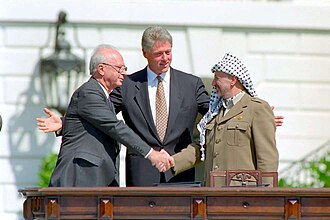
There was a time though, brief as it may have been, that peace looked like it had a chance.
In 1993, both Israeli and Palestinian leadership recognized each other officially for the first time and signed the Oslo Accords, with the Israeli Prime Minister Yitzhak Rabin and the Palestinian Liberation Organization (PLO)'s leader Yasser Arafat shaking hands at the White House after agreeing to terms.
The Oslo Accords created the Palestinian Authority to rule parts of the West Bank and Gaza Strip, and in 1995 an additional agreement split the West Bank into three zones with differing levels of Palestinian and Israeli control, with a five-year transition period planned in which they would work out resolutions for issues like the control of Jerusalem, the return of refugees, and borders.
Israeli Prime Minister Rabin, who shared the 1994 Nobel Peace Prize with his Foreign Minister Shimon Peres and the PLO's Arafat, faced heavy scrutiny by Israeli opposition leaders and the Israeli public (including from Benjamin "Bibi" Netanyahu, who led the opposition party), with many claiming that the Oslo Accords were a betrayal of the Israeli people and that Rabin was a traitor for signing it.
On November 4, 1995, Prime Minister Rabin addressed more than 100,000 people gathered in Tel Aviv for a rally supporting the Israeli-Palestinian peace process. As Rabin left the rally and walked toward his car, Yigal Amir, a 27-year-old Israeli law student, approached from behind and fired three shots.
Two bullets struck Rabin, while another wounded one of his security guards. Rabin was rushed to the hospital, where he was pronounced dead shortly after at age 73.
Many, including Rabin's widow, blamed Bibi Netanyahu's rhetoric against the Oslo Accords and the peace process for his assassination, with crowds even chanting "Bibi is a murderer".
By 1996, Netanyahu came to power and the process unsurprisingly fell apart, with a sovereign Palestinian state never coming to fruition and hostilities once again ramping up.
It is important to note that while Israel's actions in Palestine are widely supported by the majority of Jews not only in Israel but outside of it as well according to countless polls and surveys, not all Jews support Zionism nor Israel's actions in Palestine today or in years past.
There are some Israelis, even holocaust survivors, who are vehemently against Zionism and the Israeli government - though protests are often stamped down with batons and riot shields in Israel, in America there are still Holocaust survivors and groups of Jewish people who stand against Israel and seek to stop the regime from continuing their crimes.
Israel's History of Crimes Against Humanity
From its inception Israel has committed countless war crimes and crimes against humanity.
Simply listing them (even just the ones that have been verified or admitted to) would take up this whole article, so instead we'll just be taking a look at a few so you can get a good idea of what we're dealing with here.
During the 1982 Israeli invasion of Lebanon, shortly after the assassination of Lebanon's then-president-elect, Bashir Gemayel, the IDF sealed off and surrounded the Sabra neighbourhood and its nearby Shatila refugee camp (which housed Palestinian refugees) in Beirut, Lebanon.
With full control of the area, the IDF then allowed the Phalangists, a "Christian" group in Lebanon that was effectively a proxy militia used by Israel, to enter the zone and commit unspeakable atrocities while Israeli soldiers stood guard.
For nearly two days the "militia" killed, raped, and mutilated thousands of unarmed Palestinian refugees and Lebanese Shiite muslims; up to 3500 unarmed civilians were slaughtered, the subsequent discovery of the mutilated corpses drawing worldwide outrage.
An Israeli investigation found that Israel was "indirectly" responsible for the massacre; the Defense Minister, Ariel Sharon, resigned as a result, yet no disciplinary actions were taken against anyone involved in the incident.
Ariel Sharon would later be elected Prime Minister of Israel in 2001, where he led the country until 2006.
In 1994, an Israeli terrorist attack in the West Bank was perpetrated in much the same way many Islamic terrorist attacks have occurred across the west, as a lone gunman entered the Ibrahimi Mosque in Hebron wearing Israeli army fatigues and opened fired with an automatic rifle.
The terrorist, Baruch Goldstein, killed 29 Palestinians (some as young as 12) and injured nearly 150 others before survivors of the attack overpowered him and beat him to death. Palestinians took to the streets to protest the massacre and the ongoing Israeli occupation, which resulted in clashes with the IDF.
In response to these protests, Israel greatly restricted Palestinian movements in Hebron (despite the fact the West Bank is not supposed to be Israeli territory), creating checkpoints and roadblocks in the area that remain to this day even 32 years later.
In what sounds like satire but is easily verifiable, following the Jewish terrorist attack on the mosque, Israel split the mosque building into two parts - most of the building was converted into a Jewish synagogue that was made off-limits to Palestinians, leaving a much smaller space to remain a mosque.
You read that right - in response to an Israeli terrorist attack on a mosque, Israel took part of that mosque away from Palestinians and turned it into a synagogue.
While Palestine is known in the west for celebrating its "martyrs", ie. terrorists, the same can certainly be said for Israel - Goldstein's grave became an Israeli "settler" pilgrimmage site in the years that followed, with Jewish settlers regularly visiting his grave to "pay their respects" to the terrorist to this day.

In 2004, a 14-year-old girl named Iman Al-Hams was murdered by an unidentified IDF soldier near an army outpost in Rafah, an area in the Gaza Strip.
The soldier's commander, who was also never publicly identified, then proceeded to approach her body and shoot her corpse multiple times to "confirm the kill".
Palestinian hospital officials found at least fifteen bullets in the girl's body.
This incident only garnered attention outside of Palestine because the entire thing was caught on CCTV.
The soldiers claimed that they thought the girl was "planting a bomb", yet audio recordings of the radio conversation between soldiers at the scene revealed that they had clearly identified her as a child and in their own words she was "not a threat", with no mentions of a bomb or any kind of weapon; the school bag she was carrying was filled with textbooks, and one soldier even noted she looked "scared to death" of them prior to her being shot.
The unnamed soldier who killed her was never charged, but the commanding officer, who repeatedly shot her at close range and later stated over the radio "This is commander. Anything that's mobile, that moves in the zone, even if it's a three-year-old, needs to be killed. Over." as justification for his actions, was cleared of any wrong-doing in the shooting after an initial Israeli investigation.
Lieutenant General Moshe Ya'alon, who served as the army's Chief of Staff, repeatedly stated that the officer had acted properly under the circumstances (Ya'alon would later serve as the country's Minister of Defense under Bibi Netanyahu).
After further international backlash, a second investigation resulted in a military tribunal which charged the unnamed "Captain R." with two counts of illegally using his weapon, and one count each of obstruction of justice, conduct unbecoming an officer and improper use of authority.
"Captain R." was acquitted of all charges and subsequently promoted to the rank of Major; he also received compensation for the cost of his defense and his time in jail while the military tribunal took place.
The soldier who initially shot and killed Iman Al-Hams in cold blood was never even charged.
During the 2006 Lebanon War between Israel and Hezbollah, another terrorist organization that was created in response to Israeli aggression in the region, Israel murdered a Canadian Major named Paeta Derek Hess-von Kruedener.
On July 25, the IDF targeted a UN patrol base in Khiam, Lebanon, with repeated artillery fire followed by a 500kg "bunker-buster" precision-guided bomb from a fighter jet. Major Hess-von Kruedener along with three other UN observers from Austria, China, and Finland were killed as a result.
The IDF claimed the bombing was an accident (for a military that so frequently boasts about their capabilities and technology, they sure do have a lot of "accidents"), yet UN officials claim to have repeatedly warned the IDF prior to the "accident" that their ongoing artillery fire was getting extremely close to the clearly marked UN position.
Like usual, there was no further blowback on Israel or its forces.
On December 27, 2008, Israel launched Operation Cast Lead, a 22-day assault on the Gaza Strip to destroy Hamas infrastructure.
Between 1,166 and 1,417 (depending on the sources) Palestinians were killed, with hundreds of them being children.
The IDF used white phosphorus munitions extensively during the operation, which they initially denied, then claimed it was used only for smokescreens (which is legal) despite the litany of burn victims during the assault.
A local Palestinian hospital reported a 60% increase in children born with severe defects and a 110% increase in blood cancer compared to the same time period prior to Operation Cast Lead.
The IDF was also widely accused of using children as human shields during the operation, something that Palestinian terrorist groups have been made notorious for, yet the IDF was reported to have been using young Palestinian boys to enter buildings first and even inspect suspect bags; two Israeli soldiers were even convicted in Israeli military court for the use of human shields.

In an interview in 2000 that wasn't made public until 2009, the Chief Pathologist at the Abu Kabir Forensic Institute in Israel admitted that staff at the institute harvested corneas, skin, heart valves, and bones from deceased individuals without permission.
In 2010, Israel admitted that these illegal organ harvests occurred but that these practices "had stopped in the 1990's" and guidelines had since been overhauled to prevent such things. They also stated that this practice didn't target Palestinians, as the institute harvested organs illegally from all bodies that were received, including Israeli soldiers and civilians.
Israel has long been accused of harvesting organs from Palestinians both before that admission and in the decades since, and just recently in November 2025, a British-Palestinian surgeon claimed that photos of Palestinian bodies returned to their families by Israel showed clear signs of organ harvesting.
Lending credence to those claims, Israel, a country of just over 10 million people that has a very low rate of organ donation amongst its population (roughly 15%), boasts the largest human skin bank in the world.
Despite their low organ donation rate and minuscule population, Israel has a larger bank of human skin than America does with more than 35x the population, or even China with 140x the population.
Notably, skin, unlike most other parts of the human body, can be harvested up to several days after death and unlike organs, doesn't need any specialized medical equipment in place prior to or immediately after death in order to keep those parts viable, meaning it can easily be taken from corpses found far away from a hospital setting.
Surely just a coincidence, though.
In 2018, the "Great March of Return" protests began in Gaza, a series of weekly mass protests held in the Gaza Strip near its border fence with Israel, demanding that Palestinian refugees be given the right to return to the lands and homes they were stripped of during the 1948 Nakba, as well as an end to the severe blockade imposed on Gaza by Israel.
The unarmed civilian protests occasionally resulted in rocks being thrown toward the Israeli border fence and tires being burned in their own streets (both things often seen at protests around the world) - in response, the IDF regularly fired live ammunition at the protestors to disperse the crowds.
IDF snipers were found to be deliberately targeting clearly designated journalists and medics, and most disturbingly, young children, with many victims being "kneecapped" by Israeli shooters.
At least 13,000 civilians were shot and 220 were killed during the 18 months of protests by Israeli forces, with their use of force resulting in incidents where Palestinians sent incendiary kites and balloons toward the border (which only further fueled IDF shooting sprees).
The staggering amount of gunshot wounds and severe injuries (including many which required amputation) drew international condemnation, yet that didn't stop Israel from continuing to shoot civilians.
The IDF meanwhile reported one fatality and just four injuries during the entire stretch of protests.
On May 11, 2022, Palestinian-American journalist Shireen Abu Akleh, who worked for Al Jazerra for over 25 years, was shot in the head by Israeli forces while wearing a clearly marked blue PRESS vest and helmet to cover a raid on a refugee camp in the West Bank.
Tens of thousands of people carrying Palestinian flags and chanting nationalist songs took to the streets for her funeral, which is believed to have been the largest Palestinian funeral in Jerusalem in over two decades.
Claiming the crowds were disrupting public order and the chants were "incitement", and later accusing the crowd of "throwing rocks", the Israeli police stormed the funeral procession, attacking even the pallbearers with batons in footage that would spread like wildfire on social media.
The Saint Joseph's Hospital in East Jerusalem was then stormed by police officers, who assaulted patients and threw stun grenades, wounding and burning staff and patients alike in the building alongside funeral-goers.
Just over a year later, on October 26, 2023, the Israeli military bulldozed a memorial that had been erected at the site where Abu Akleh was murdered.
Israel initially denied any responsibility for Abu Akleh's death and blamed Palestinian militants for shooting her. After several independent investigations were undertaken by various international media outlets, the UN, and the US State Department, Israel finally admitted she was likely "accidentally" killed by Israeli fire, yet Israel refused to open a criminal investigation (not that their criminal investigations ever amount to much in terms of repercussions).
Forensic Architecture, a research group at the University of London that was led by Eyal Weizman, who is Jewish himself, refuted Israel's findings of an "accidental" shooting and stated Abu Akleh was deliberately targeted and denied medical aid after she was shot.
259 journalists and media members have been killed by the IDF in the last three years alone.
In November 2022, the United States Department of Justice opened a separate investigation into Abu Akleh's killing, in a move that Israel condemned and refused to cooperate with, yet nothing public ever came from that investigation; as usual, Israel suffered no consequences.
This past May, Israel illegally detained 12 civilians on an international aid flotilla, including Dr. Margaret Connolly, the sister of the current Irish President.
Connolly and the other "detainees" were intercepted in international waters by Israel as part of a flotilla that was attempting to deliver medical and humanitarian aid to Gaza, which Netanyahu claimed was "a malicious plan designed to break the isolation we have imposed on Hamas terrorists" despite the fact that their plan is imposed on millions of civilians and not just terrorists.
The detainees were eventually released by Israel, after which they claimed they were beaten, stuffed in an overcrowded cold metal room, suffered fractured bones and even claimed to have suffered sexual violence at the hands of Israeli forces.
Despite the highly connected political stature of one of those detainees, the story has already been forgotten with no repercussions to any IDF forces involved.
American journalist Josh Rushing was given an Emmy Award for his investigative documentary Kids Under Fire which examined accounts from American doctors who volunteered to treat patients in Gaza, with a growing list of testimonies from doctors from many different countries that have described the brutal injuries inflicted on children by IDF forces.
One such doctor, Dr. Mark Perlmutter, a Jewish American who went to Gaza on a humanitarian mission in 2024 and on another in 2025, has been very outspoken about the horrors he witnessed in Palestinian hospitals, including children who were shot multiple times by IDF soldiers.
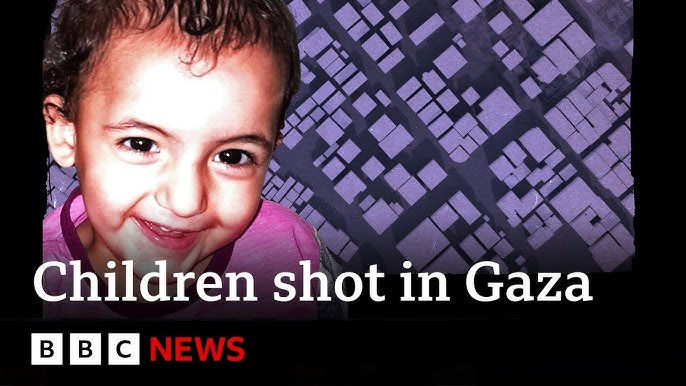
The BBC released a report with evidence that at least 160 Palestinian children, including 95 that were under the age of 12, were shot in the head or chest by Israeli snipers during the current war in Gaza, with incidents occurring not only in active war zones, but in IDF-designated safe zones as well.
Often, "stone-throwing" is used as an excuse by the IDF to engage civilians including children, as if a child throwing a rock is justification for shooting them dead, yet even those accusations tend to be bullshit - here, IDF soldiers were caught on video placing a rock next to a 14-year-old boy who was bleeding out after being shot by soldiers, taking pictures to "justify" their shooting, all while the child was still alive.
That 14-year-old boy ultimately died not only from being shot, but due to the delayed medical attention the soldiers failed to provide as they stood around and took pictures.
Speaking of children, Israel finally admitted to "accidentally" killing Hind Rajab recently, a five-year-old Palestinian girl who was brutally murdered on January 29, 2024 in Gaza.
According to forensic evidence, a tank fired an explosive round at a Kia Picanto from roughly 20 metres (~65 feet) away.
The car was carrying a family of seven as they tried to flee from Israeli military operations in Gaza, and included several children; based on the distance, angle, and vehicle, experts have stated that there was virtually no way that the tank operator(s) would not have been able to clearly see that the vehicle contained small children and was not a threat.
The initial strike killed her uncle, aunt, and three of her cousins, leaving just Hind and her 15-year-old cousin Layan Hamadeh alive.
Layan called the Palestinian Red Cresent Society (PRCS) for emergency aid, crying as she stated that the tank was "right next to us"; the dispatcher then heard screaming as the sound of gunfire ripped through the vehicle before the call was disconnected.
That volley killed Layan, leaving Hind alone, injured but still alive in the vehicle, surrounded by the bodies of her family.
When the PRCS called back, little Hind Rajab answered (the phone calls were published in full by the PRCS following the incident), with the dispatchers instructing her to stay hidden in the vehicle as they coordinated with Israeli officials to send help - she can be heard repeatedly stating that she was scared and asking for them to come take her away.
The PRCS worked with the Gaza Health Ministry and the Israeli military to guarantee safe passage to an ambulance in order to rescue the girl in the besieged area.
Nearly three hours later, the PRCS was finally given approval to send an ambulance with two paramedics to the scene along a designated route. The two paramedics reported being targeted by "lasers" on their way to the scene and remained in contact with dispatch until the sound of gunfire and an explosion disconnected their call.
Twelve days later, when Palestinians were allowed back into the area, the vehicle was discovered with the bodies of all seven occupants, including little Hind Rajab; at least 335 bullets had struck the vehicle following the initial tank shell which immobilized it.
Just a few feet away, the PRCS ambulance sat in ruin, completely demolished by an explosive tank round (presumably fired by the same tank) with its two paramedics found dead inside.
Israel initially denied ever having tanks in the area, even though satelite imagery proved at least three IDF tanks were in the vicinity that day. Investigations also proved that the ambulance that was struck was indeed given clearance by Israel to be there.
Over two years later, Israel finally acknowledged that its troops fired at the vehicles, and announced a criminal investigation (which, if their history is any indication, will amount to nothing).
On August 25, 2025, Israeli tank rounds hit the Nasser Hospital in Gaza, ravaging an upper floor and killing a Reuters cameraman.
As medics and journalists made their way to the scene a short time later, with first responders clearly visible in this video attempting to help the wounded, the IDF hit the hospital with another strike, killing medical staff and civilians that were trying to help the victims of the first strike, as well as five journalists from Reuters, the Associated Press, and Al Jazeera.
The "double-tap" was fully caught on video, a method of military targeting that Israel is notorious for - after hitting a target, IDF forces will wait until first responders arrive at the scene before striking the target again, maximizing casualties.
The illegal strike on a hospital and its brutal "double-tap" killed at least 22 people and wounded at least 50 more; Israeli Prime Minister Netanyahu called the incident a "tragic mishap", with the IDF claiming they targeted a "camera used by Hamas".
No, you didn't read that incorrectly - Israel's excuse for killing 22 people at a hospital, which is a blatant war crime, was that they were targeting a camera.
Of course, no evidence was ever produced that there was a deadly "Hamas camera" being used at the facility.
These incidents are astoundingly frequent throughout Israel's history, and are widely dismissed as "disinformation" or even "blood libel" by Israel, only acknowledged when they're caught on camera or have overwhelming evidence against them, at which point Israeli leadership chalk it up to an "accident".
The Real Aggressors
While the IDF claims to have a lot of "accidents", at the same time, Israel routinely boasts about its technical abilities and committment to "moral" military doctrine.
Just take a look at this piece published by Haaretz, where the Israeli military called off a planned night-time strike in Southern Syria against "Syrian militants" because the IDF noticed the men had traditional Jewish "sidelocks" on their heads, indicating they were Orthodox Jews returning to Israel rather than Syrian insurgents.
The IDF can apparently make out hair on the side of someone's face from a distance in the middle of night, but regularly can't tell the difference between combatants and small children in broad daylight.

During the "current" war in Gaza (more on October 7 and the current conflict is coming in a future part of this series), over 80% of the buildings in Gaza have now been completely demolished, as you can see in aerial imagery here while US President Donald Trump boasts about sending Israel weapons; at least 75,000 Palestinians have died with thousands more missing, with the IDF reporting a roughly 1:1 civilian-to-combatant kill ratio according to the counts they've released.
That number is dubious at best (other estimates have a far higher rate of civilian deaths to combatants, but both Hamas and Israel have proven untrustworthy when it comes to reporting combatants vs. civilians and inflating or deflating counts), but taking them at their word, that is a horrendous ratio for what is touted as the "most moral army in the world" (according to Israel).
Just take a moment to consider how Russia is vilified by western media outlets and politicians, with their "invasion" of Ukraine being deemed an act of evil as they are accused of wanton violence against civilians.
Hilariously, Ukraine and western groups claim a minuscule amount of military casualties despite the average age of Ukrainian soldiers now passing 40 due to the amount of young men who have been killed, and astronomically high rates of Ukrainian casualties compared to Russians when the two sides do "body exchanges" - ie. the two sides hand over collected corpses so their dead can be buried, with Russian casualties regularly being in the single or low-double digits while Ukrainians receive thousands at a time.
Even using an extremely conservative estimate like ones released by NATO that claim just 150,000 Ukrainian soldiers have perished in the conflict, the civilian-to-combatant kill ratio for the Russian forces would be roughly 1:10, meaning "bloodthirsty" Russia kills 10 combatants for every one civilian that dies.
Compare that to the IDF, where using their own statistics (which is dubious at best), they kill as many combatants as they do innocent civilians, or roughly 10x more than Russia (likely far, far higher in reality).
Israel's list of documented and verified war crimes is lengthy and continues to grow to this day, yet for some reason, Israel and the Jewish community is perpetually portrayed as a victim.
Through its own creation and its ensuing actions, Israel kicked a hornet's nest and gave a group of people who are part of a religion that is prone to "extremist" tendencies, a damn good reason to resort to extremism, locking the two sides in a battle that will never cease until one side or the other is destroyed.
Even the founder of the modern state of Israel, David Ben-Gurion, admitted that they were the aggressors, something that modern Israeli leadership would never admit today. In a meeting with Jewish leaders in 1938, a decade before Israel would declare its official statehood, Ben-Gurion stated, "Let us not ignore the truth among ourselves... politically we are the aggressors and they defend themselves... The country is theirs, because they inhabit it, whereas we want to come here and settle down, and in their view we want to take away from them their country."
Not only that, but because Israeli leadership has stood adamantly opposed to a Palestinian state ever being formed, Israel has repeatedly propped up and even funded extremist groups in Palestine to undermine any attempts at diplomacy and uniting the Palestinian people into forming a proper government.
In this 2009 speech on the House Floor, Ron Paul gives an excellent breakdown of how Israel supported Hamas in order to bring down Palestinian leader Yasser Arafat's attempts to establish a Palestinian state.
Israel openly helped Hamas grow and later get elected, then used the fact that the Palestinians "elected a terrorist organization" against them and used it as justification for never allowing Palestinian statehood, ignoring the hypocrisy of such logic given that Israel itself was formed entirely by terrorist groups.
He also touches on America's brilliant efforts from the 1980's to radicalize Muslim populations in order to use them against the Soviet Union, something that the world is still suffering the consequences of to this day.
Even after Hamas was designated a terrorist organization not only by Israel but much of the western world, Israeli Prime Minister Bibi Netanyahu allowed millions of dollars in cash to flow from Qatar to Hamas every month, effectively allowing Hamas to become a regional power.
His explanation was that if they could keep Hamas in power, they'd be able to reduce the pressure for a Palestinian state and "control the height of the flames" as he would state in a leaked interrogation video that was released in the excellent "The Bibi Files" documentary.
This short video offers a clear and accurate summary of Israel's funding of Hamas through Qatar, and how it led to Hamas' ability to perpetrate the October 7, 2023 massacre (which will be covered in much more detail in later entries in this series).
These tactics weren't limited to Hamas either.
Al Qaeda, the group that coordinated and executed the 9/11 attacks on America with the express intent to destroy the western world, has suspiciously failed to pull off any other major attacks in any other western nation since.
Despite Israel's proximity to Al Qaeda cells in the middle east, Al Qaeda has also never targeted Israel, something that the former head of Shin Bet (Israel's internal intelligence service - effectively Shin Bet like Israel's FBI, with Mossad being the CIA) struggled to attempt to explain in this interview, as the interviewer also brought up the fact that Israel was treating Al Qaeda and other terrorist soldiers (including ISIS) at its border so that those groups could continue fighting against the Syrian government during the Syrian Civil War.
Following Syria's lengthy internal war, a former Al Qaeda member who created the Al Nusra Front (an affiliate group in Syria that had the blessing of Al Qaeda's central command) became the country's new President and has been paraded around the White House even as Muslim militants continue to murder Christians, Druze, and Aliwite Muslim populations in the country.
The truth is, Israel's historical aggression, with the United States and other western nation's support, created the massive clusterfuck that is the middle east today.
Israel's aggression has inspired the formation of countless terrorist groups (including many that have been funded or aided by Israel and the US) that cause chaos not only in the desert, but attack western nations far outside of it as well.
There were no Islamic terrorist attacks on western nations prior to the creation of Israel and the decades of turmoil that followed, from both Israel and the United States' actions (and to a lesser extent, other NATO countries).
Israel was quite literally the first modern "terrorist state" and deserves to be recognized as such; it was formed by and of terrorist "militias" and continues to commit atrocities to this day.
Stay tuned for the next article in this series, as today's piece is just the tip of the iceberg; still to come is an in-depth look at the modern Israeli lobby in the US, Israel's history of false flag operations, Israel's support of pedophile and trafficking networks, and much more.


Comments